
Conducted: Independent study - With and without attractant
We have conducted a field study evaluating the Gobble Sticky PRE 4.0 and its effect when trolling for zander. The study shows that using Gobble on the wobbler caught both more and larger fish.
Read more about the products HERE
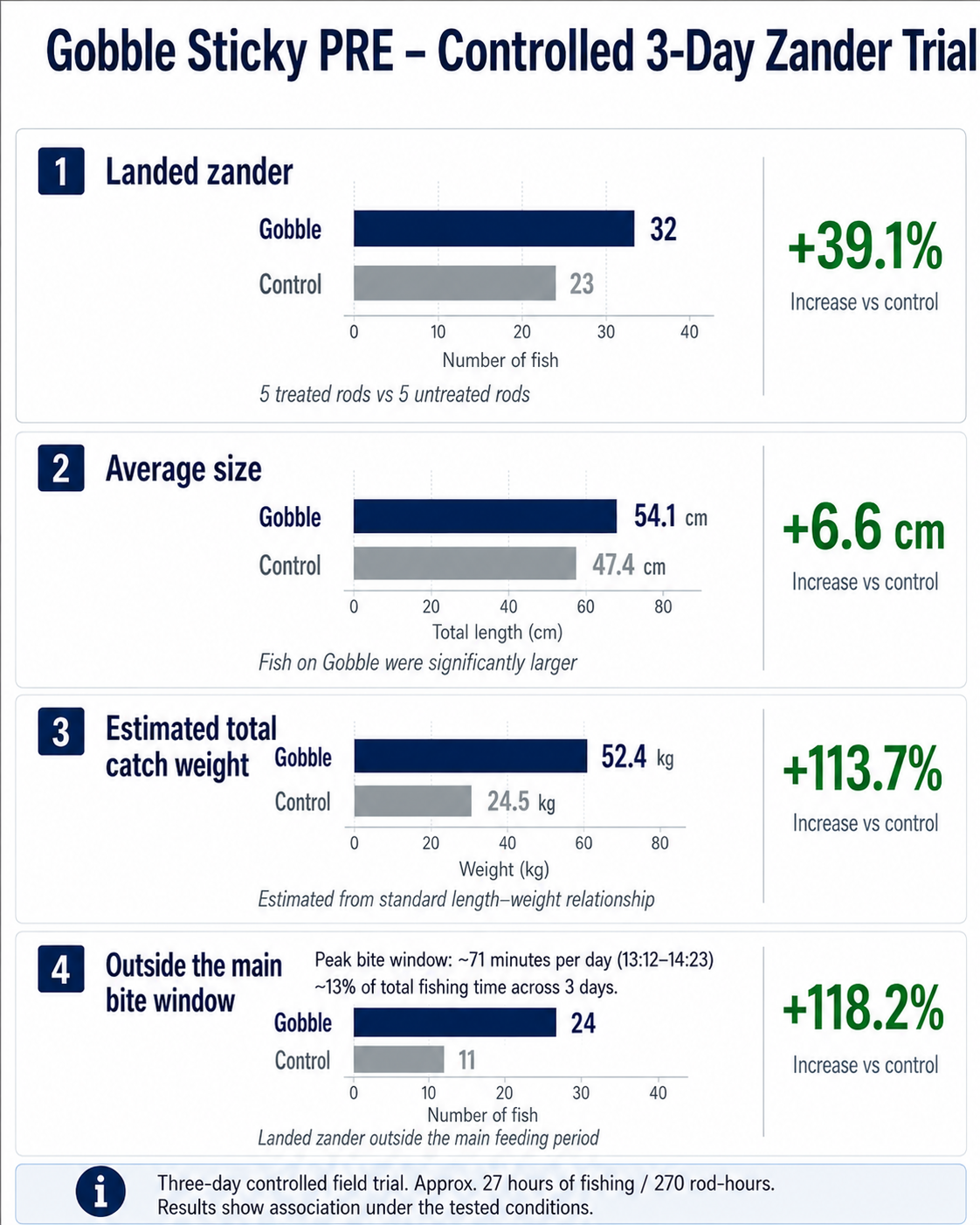
Ten rods were used (five treated, five untreated).
Briefly summarized:
The data indicates a significant advantage for the baits treated with Gobble, across all key parameters:
Catch rate: 32 landed zander on Gobble versus 23 on control (+39.1%).
Fish size: Treated baits consistently caught larger fish (average of 54.1 cm versus 47.4 cm).
Furthermore, the four largest zander in the study (76, 75, 74 and 68 cm) were all caught with Gobble.
Total yield: Estimated total catch weight more than doubled, with 52.4 kg for Gobble compared to 24.5 kg for control (+113.7%).
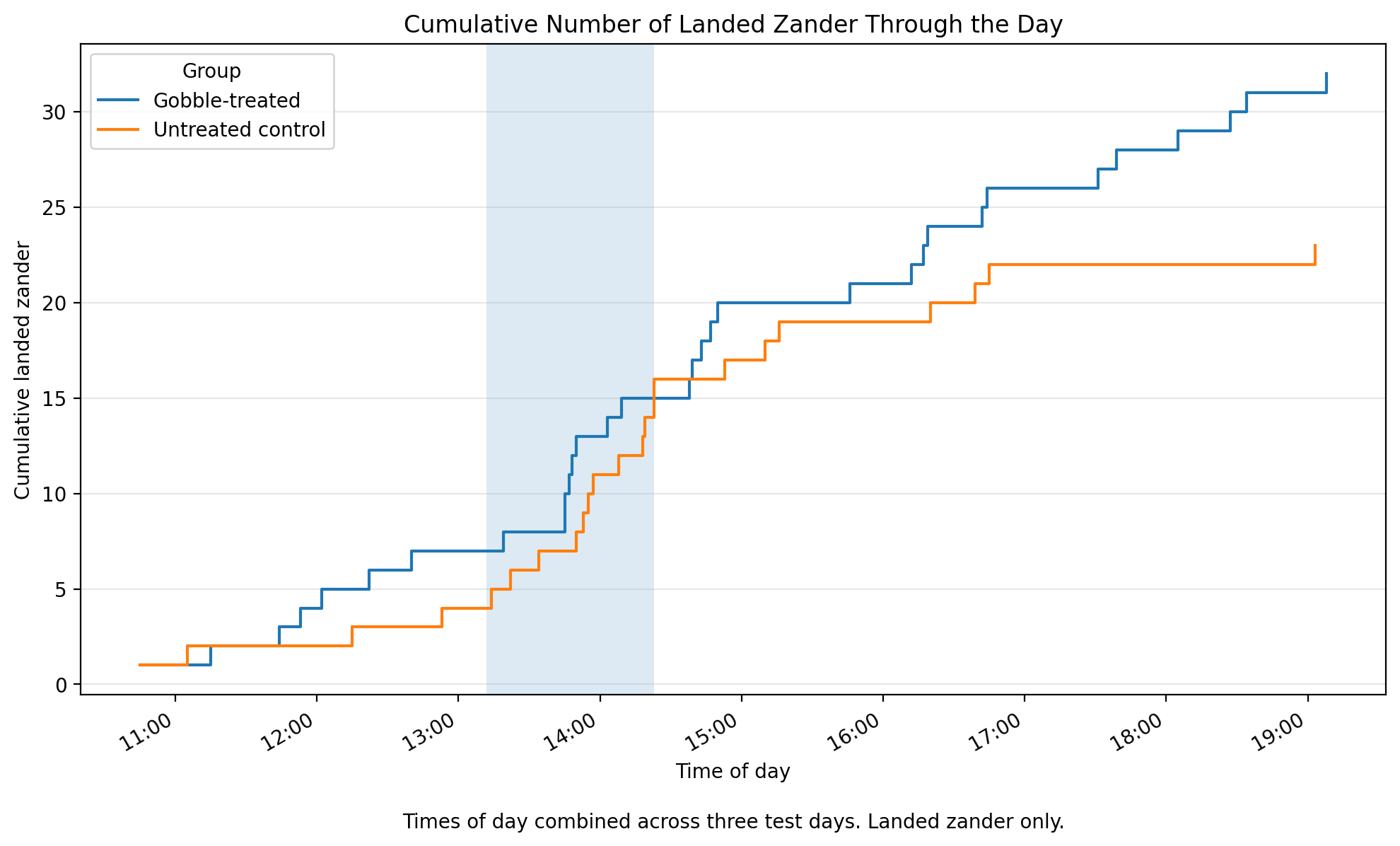
Gobble Sticky PRE 4.0 – Complete Summary of Three-Day Dosing Study
Gobble Sticky PRE was evaluated in a three-day field study with pelagic trolling following zander in Sweden. Ten rods were used at the same time:
Five rods of Gobble treated bait
Five rods with untreated control bait
During the main trial, the Gobble rods landed 32 zander compared to 23 on the control rods. The gudgeon caught on Gobble were also significantly larger on average, and their estimated total weight was more than double the control catch. A separate pilot day conducted before the main trial showed the same overall pattern, with both more and larger fish caught on Gobble-treated baits.
The test was conducted by Emil Lindgren through his company, Pelagisk Puls. Emil works as a fisheries consultant for various organizations and authorities in Sweden. He is one of only two consultants in Sweden who both catch fish for research projects and perform implantation or attachment of acoustic transmitters, PIT tags and GPS transmitters.
Read more about the products HERE
His relevant qualifications include:
Certification for fish labeling according to SJVFS 2019:25
Laboratory animal training for fish according to SJVFS 2019:9
Training in restoration of watercourses
BAS-P/U qualifications in HSE coordination
His relevant project experience includes catching and tagging hundreds of fish, including:
140 zander caught by trolling and equipped with acoustic transmitters (2021 and 2022)
125 zander caught by vertical fishing and equipped with acoustic transmitters (2023)
120 zander caught by vertical fishing (2024), and another 120 zander (2024)
Fieldwork in Mongolia with the capture of taimen, lenok, Amur pike and Amur trout (2025)
Tagging of salmon, trout, pike, tuna and asp over several years (2023–2026)
This background gives Emil extensive practical experience with eel behavior, pelagic fishing, bait presentation, boat positioning, catching, and scientific fieldwork.
Pilot Day
A pilot test was conducted immediately before the three-day main trial began. The pilot day yielded the following results:
Gobble: 24 landed zander
Control: 17 landed zander
Average length Gobble: approx. 55.0 cm
Average length control: approx. 48.0 cm
This represents approximately 41% more landed zander during the pilot day. The pilot data were not merged with the data from the main trial and are not included in the formal statistical analysis. The pilot was conducted before the final three-day protocol began and is therefore presented separately. However, it showed the same general pattern independently of the main study: more and larger fish on Gobble-treated baits.
The main experiment was conducted over three consecutive days. The setup included:
Ten rods fished simultaneously (five with Gobble Sticky PRE 4.0 , five as control)
Approximately 27 hours of fishing (approximately 270 total rod hours / approximately 135 rod hours per treatment)
Bait: Rapala Scatter Rap Husky
Matching bait colors and corresponding fishing positions
Trolling speed of approximately 2.2–3.0 knots (measured as GPS speed over ground)
Approximately 35 meters of line behind the boat
Most baits were fished at about three meters depth (additional positions at about six and eight meters)
Four rods with a paravan and one deeper rod on a deepwater rig on each side
The surface water temperature during the test ranged from approximately 20.9 to 24.0 °C, with air temperatures of approximately 26–31 °C. The thermocline (interference layer) was estimated to be located at approximately 15 meters. All baits tested were therefore fished above the thermocline. The baits were fished at the same time, which exposed both treatments to essentially the same weather conditions, trolling speeds, fishing activity, and environmental conditions.
Treatment distribution and placement in the boat
The decision to keep the Gobble rods on one side of the boat and the untreated rods on the other was discussed before the study. It was a deliberate part of the practical setup, and not an overlooked design weakness.
Based on his extensive previous experience with sculpin fishing and research work in the same area, Emil's assessment was that one side of the boat would not consistently outperform the other over the three-day test. This fixed positioning also had practical advantages:
Reduced the risk of mixing treated and untreated baits
Simplified handling of ten rods
Helped maintain a consistent fishing configuration
Made it possible to fish both treatments simultaneously and reduced the risk of treatment errors during the test
Main catch results
zander contacts:
Gobble: 34
Control: 26
Difference: Eight additional contacts (observed increase of 30.8%)
Landed zander :
Gobble: 32
Control: 23
Difference: Nine additional fish landed (observed increase of 39.1%)
Lost zander / Landing rate:
Gobble: Two lost (94.1% landing rate)
Control: Three lost (88.5% landing rate)
Approximate catch rate:
Gobble: 0.24 zander landed per rod hour (approximately one fish per 4.2 hours)
Control: 0.17 landed zander per rod hour (approximately one fish per 5.9 hours)
Fish size
The fish landed on Gobble were on average larger:
Average length Gobble: 54.06 cm
Average length control: 47.43 cm
Difference: 6.63 cm (relative difference of approximately 14.0%)
Total length of landed fish:
Gobble: 17.30 meters
Control: 10.91 meters
Difference: 6.39 meters (+58.6%)
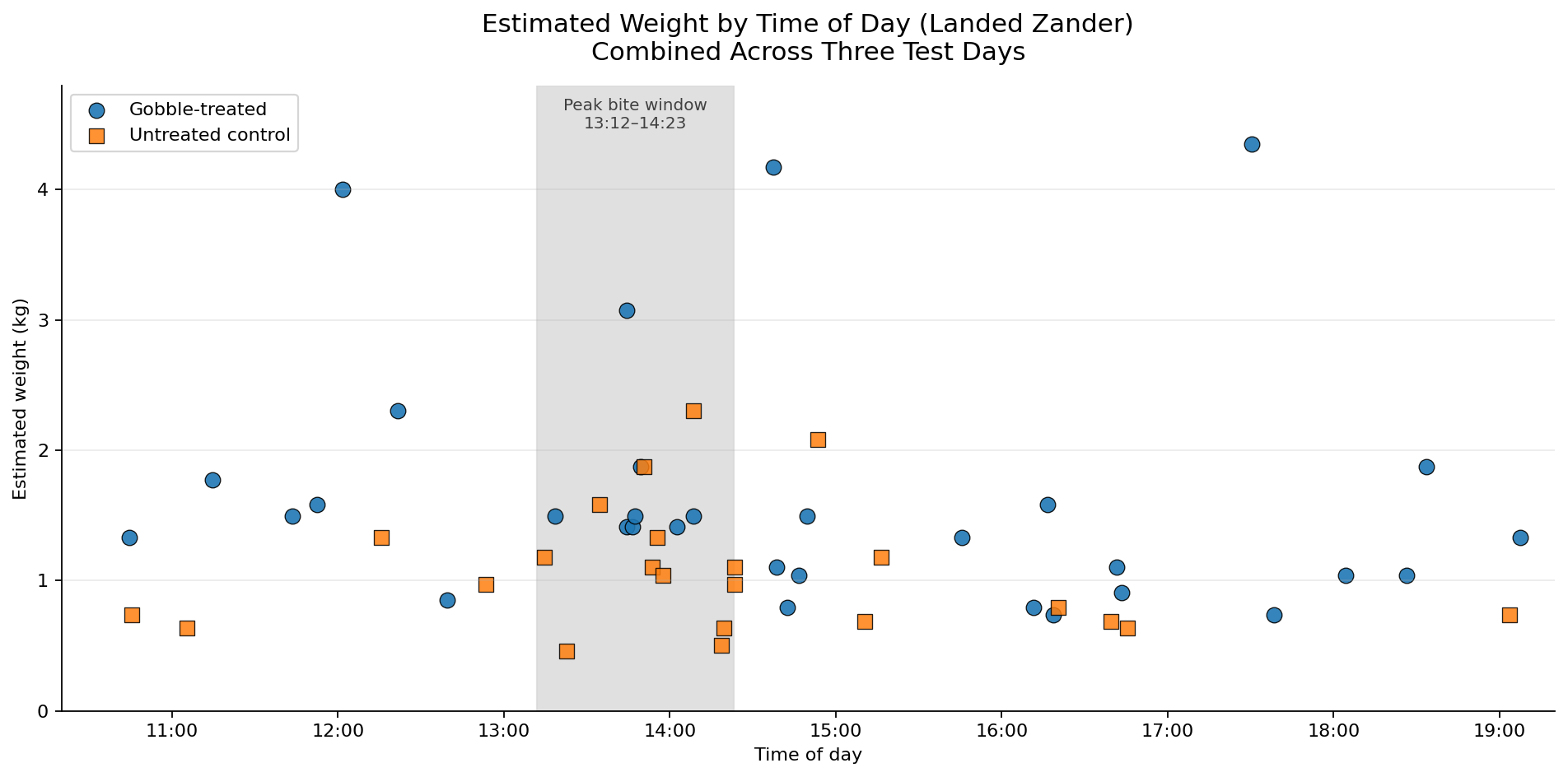
The four largest zander in the main experiment were all caught on Gobble-treated baits (76, 75, 74 and 68 cm). The largest control fish was 62 cm. The difference in fish length was statistically significant using several analytical approaches (Welch's t-test: p ≈ 0.0027, Mann-Whitney test: p ≈ 0.0032). A sensitivity analysis where extreme fish were removed did not eliminate the size difference.
Estimated catch weight
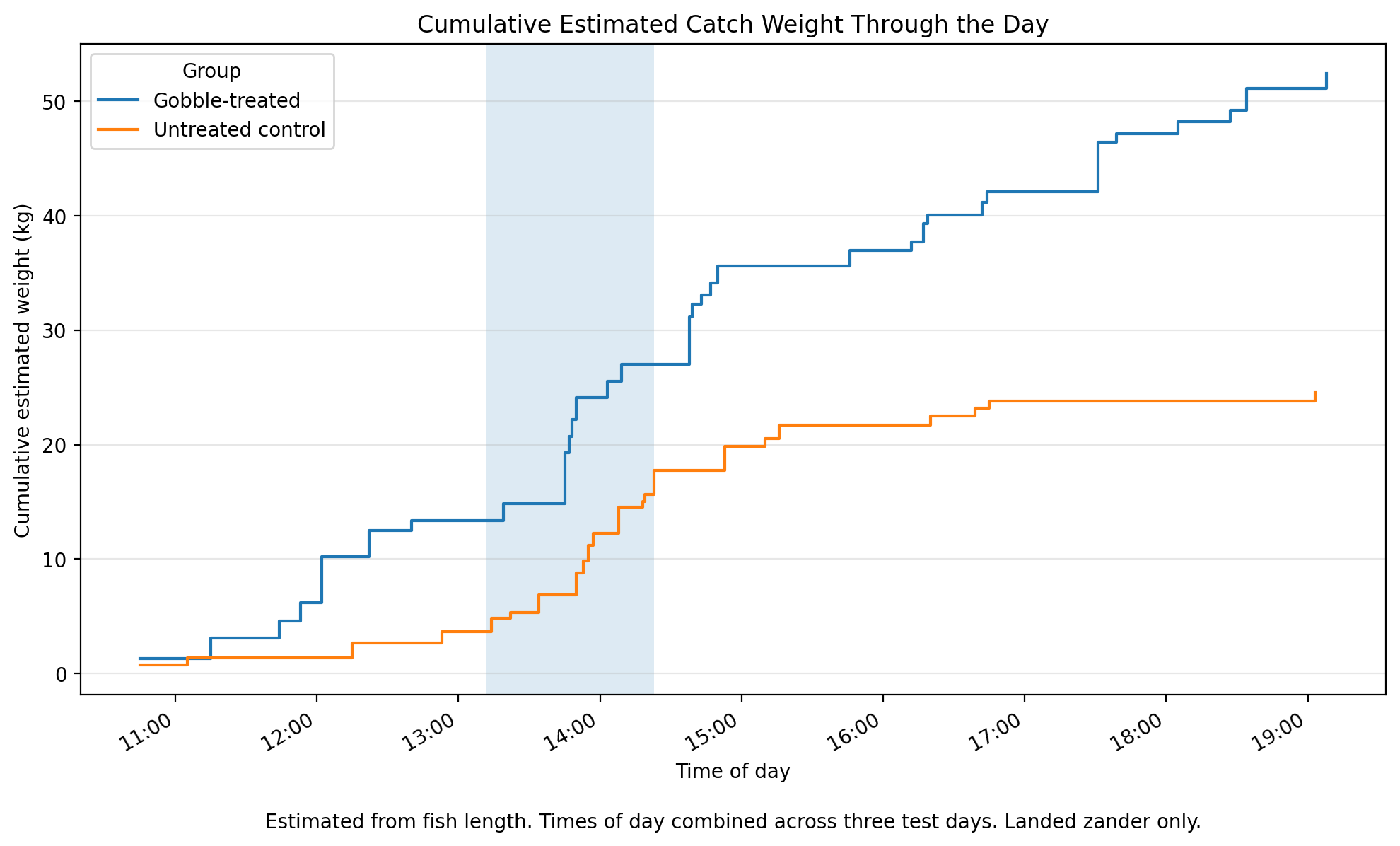
The fish were measured but not individually weighed. The weight was therefore estimated from the length using a standard length-weight relationship for zander (Estimated weight in grams = 0.00589 × length in centimeters^3.12).
Estimated average weight :
Gobble: approx. 1.64 kg
Control: approx. 1.07 kg
Estimated total landed weight:
Gobble: approx. 52.42 kg
Control: approx. 24.53 kg
Difference: approximately 27.89 kg (observed increase of 113.7%)
Gobble-treated baits therefore produced more than twice the estimated total weight.
Bycatch (Other species)
In addition to the zander, the following species were recorded:
Gobble: Two pike, one perch
Control: Two pikes
Total contacts across all species: Gobble 37, Control 28. The main analysis is based on zander only, as this was the aim of the study.
Working hypothesis and bite periods
Prior to the study, the working hypothesis was that Gobble would provide its greatest practical benefit during periods when fish were less active in their foraging. The most clearly defined main bite period was approximately 13:12–14:23 (approximately 71 minutes per day, accounting for around 13% of total fishing time).
During the main bite period:
Gobble: 8 landed zander
Control: 12 landed zander (Around 52% of the entire control catch occurred in this short window, while for Gobble it only accounted for 25% of the catch).
Outside the main bite period:
Gobble: 24 landed zander
Control: 11 landed zander (Observed increase of 118.2% for Gobble).
Late afternoon analysis (15:35–18:34) : During this slower period, Gobble landed 11 zander compared to the control's 3 zander (+266.7%) . This pattern supports the hypothesis that odor may have greater practical value when fish are not actively feeding.
Statistical interpretation
The difference in average fish length was statistically significant. The difference in the number of fish landed is most correctly presented as an observed difference rather than a statistically proven increase in catch rate, due to the limited sample size and the fact that the rods were grouped per boat side without randomization. The numerical results are very encouraging, but the main catch result should not be described as definitive proof of a causal relationship.
Overall conclusion
The pilot day and the three-day main trial both yielded the same overall pattern: Gobble-treated baits caught more and larger zander than untreated baits.
In the main experiment:
Five Gobble-treated lures landed 32 zander (average 54.1 cm / 52.4 kg estimated total weight)
Five untreated lures landed 23 zander (average 47.4 cm / 24.5 kg estimated total weight)
The largest difference occurred outside the short bite period when the fish were most active. The results are both commercially and scientifically interesting, and provide a strong basis for further independent testing. The most accurate conclusion is that the study provides strong and encouraging field evidence for a link between Gobble treatment and improved catches of zander.
Low activity performance:
There were short bite periods each day when the zander apparently took everything. This lasted for about an hour. During this period, the result was not improved by Gobble.
The remaining 87% of the day, the Gobble baits were superior, landing 24 fish compared to 11 on the control (+118.2%).
During the slowest afternoon period (3:35 PM–6:34 PM), this difference increased to 11 to 3 (+266.7%).
Read more about the products HERE
Read our FAQ here HERE
Contact us HERE
Portions of this article were compiled using artificial intelligence. All content has been reviewed and quality-assured by Gobble Bait before publication.
